
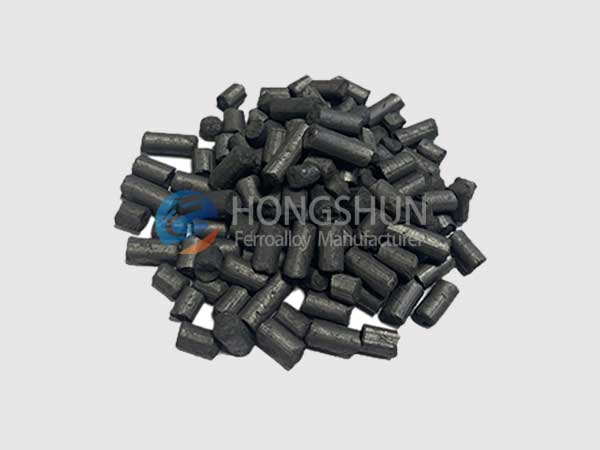
HS supply cylindrical carbon raiser, graphite particle carbon raiser, graphite powder carbon raiser, petroleum coke carbon raiser, factory direct sales, competitive price, can be customized according to customer requirements content and granularity.
Carbon raiser or carbon additive, a carbon-containing substance added to supplement the carbon content burned during the smelting process of steel is called carbon raiser. High-quality recarburizer is an essential auxiliary additive for the production of high-quality steel.
There are many kinds of raw materials for carbon raiser and the production processes are also different, including wood carbon, coal carbon, coke, graphite, etc., among which there are many small types under various categories. High-quality carburizers generally refer to carburizers that have been graphitized. Under high temperature conditions, the arrangement of carbon atoms takes the microscopic form of graphite, so it is called graphitization. Graphitization can reduce the content of impurities in the carburizer, increase the carbon content of the carburizer, and reduce the sulfur content.


Why does the metallurgical industry need recarburizers?
- During the smelting process of steel products, due to the long smelting time and heat preservation time, the carbon content in the molten iron may be lost significantly, resulting in a reduction in the carbon content in the molten iron and failing to reach the expected theoretical value for steelmaking. To compensate for this loss in carbon content, carburizers are added.
- In addition, for castings, cast iron, cast steel, and castings, there will be a requirement for carbon. So the carburizer, as the name suggests, is to increase the carbon content in the molten iron.
- For example, the commonly used charge materials in smelting are pig iron, scrap steel, recycled steel, etc. The carbon content of the furnace charge and pig iron is high, but the purchase price is one section higher than that of scrap steel. Therefore, increasing the amount of scrap steel, reducing the amount of pig iron, and adding carburizer can play a certain role in reducing the cost of castings.
focus on ferroalloy production, quality first!
Leave your requirements, FREE quotation!
call us: +8618837209569Types of carbon raiser
GPC Graphitized Petroleum Coke
High-quality green petroleum coke is sent into the furnace for graphitization treatment at a temperature of about 2500-3600°C. This product has a high degree of graphitization and a nitrogen content of less than 300ppm. This product has low sulfate, ash, volatile matter and moisture content, making it an ideal recarburizing agent for the steelmaking and foundry industries.
| item | Fixed carbon | Sulphur | Ash | Volatile matter | Nitrogen | Moisture | Size (mm) |
| GPC-01 | 99% min. | 0.03% max | 0.5% max | 0.5% max | 0.01% max | 0.5% max | 1-3/1-5 |
| GPC-02 | 98.5% min. | 0.05% max | 0.7% max | 0.8% max | 0.03% max | 0.5% max | 1-5/5-10 |
| GPC-03 | 98% min. | 0.07% max. | 1% max | 1% max | 0.03% max | 0.5% max | 0.2-1 |
| GPC-04 | 98% min | 0.1% max | 1% max | 1% max | 0.05% max | 0.5% max | 0-0.5 |
CPC Calcined Petroleum Coke
Calcined petroleum coke (CPC) is obtained by heating green petroleum coke at temperatures up to 1400°C. With high conductivity, low resistivity and about 98.5% fixed carbon, it is widely used in aluminum anodes, graphite electrodes and other carbon-consuming industries.
The largest user of calcined petroleum coke is the aluminum industry, 70% of which is used to make anodes that reduce bauxite.
Calcined petroleum coke is a hard solid petroleum product, black or dark gray, metallic, porous, composed of tiny graphite crystals, columnar or needle-shaped carbon particles. Calcined coke is produced by calcining petroleum at 1200 degrees in rotary kilns and retort furnaces to remove impurities in the coke, such as volatile matter and ash.
Calcined petroleum coke has three applications in the carbon industry:
- Carburizing agent for aluminum smelting,
- carburizing agent for steel smelting,
- raw materials for manufacturing gypsum electrodes and prebaked anodes
| ltem | Fixed carbon | Sulphur | Ash | Volatile matter | Moisture | Size (mm) |
| CPC-01 | 98.5% min. | 0.5% max | 0.7% max | 0.8% max | 0.5% max | 1-3/1-5 |
| CPC-02 | 98.5% min. | 0.8% max | 0.7% max | 0.8% max | 0.5% max | 1-5/30-60 |
| CPC-03 | 98.5% min | 1% max | 0.5% max | 1% max | 0.5% max | 1-3/5-20 |
| CPC-04 | 98.5% min. | 2% max | 0.5% max | 1% max | 0.5% max | 1-5 |
| CPC-05 | 98.5% min. | 3% max | 0.5% max | 1%max | 0.5% max | 0-2 |
CAC Calcined Anthracite Coal
During the electric arc furnace steelmaking process, coke or anthracite can be added as a carburizing agent during charging. Due to its high ash and volatile content, cast iron melted in induction furnaces is rarely used as a carburizing agent.
| ltem | Fixed carbon | Sulphur | Ash | Volatile matter | Moisture | Size (mm) |
| CAC-01 | 95% min. | 0.2% max | 3.5% max | 1.5% max | 0.5% max | 1-5 |
| CAC-02 | 93% min. | 0.3% max | 5.5% max | 1.5% max | 0.5% max | 1-5 |
| CAC-03 | 90% min | 0.3% max | 8.5% max | 1.5% max | 0.5% max | 1-5 |
Why choose us


one-stop service


The main function of carbon raiser
- Compensate the carbon content lost during the steel smelting process and increase the carbon content in the molten iron.
- Enhance the nucleation ability of molten iron, refine the grains, and improve the mechanical properties such as tensile strength, hardness, wear resistance and fatigue limit of castings.
- Improve the distribution of carbon and alloy elements in the cast metal, make the structure in the casting dense and uniform in composition, and eliminate the segregation phenomenon produced during the casting process.
- Reduce the amount of slag generated, simplify slag removal operations, and improve casting efficiency.
- Improve the fluidity of molten metal, stabilize the composition of molten iron, and prevent segregation.
- After use, it can significantly reduce the whitening phenomenon, improve the cutting performance, and improve the mechanical properties.


How to add and use carbon raiser?
- Furnace input method
When using carburizer in medium frequency electric furnace smelting, it can be added to the middle and lower parts of the electric furnace according to the ratio or carbon equivalent requirements, and the recovery rate can reach more than 95%; if the carbon amount is insufficient, adjust the carbon time and clean the slag in the furnace first. , add carburizing agent, and dissolve and absorb the carbon through heating of the molten iron, electromagnetic stirring or manual stirring. The recovery rate can be about 90%. If a low-temperature carburizing process is used, that is, only a part of the charge is melted, and the temperature of the molten molten iron is lower. In this case, all the carburizing agent is added to the molten iron at one time, and at the same time, it is pressed into the molten iron with solid charge to prevent it from being exposed on the surface of the molten iron. This method can increase the carburization of molten iron by more than 1.0%. - Carburization outside the furnace
Including spraying graphite powder in the ladle and using carburizer when tapping the iron.
- Graphite powder sprayed inside the bag
- Using graphite powder as carburizer, the air blowing volume of 40kg/t can increase the carbon content of molten iron from 2% to 3%. As the carbon content of molten iron increases, the carbon utilization rate decreases.
- Use carburizer when tapping iron
- The method of using carburizing agent when tapping the iron is to first put the graphite powder carburizing agent into the bag, or flush it with the flow of the iron outlet tank. After discharging the iron, stir it thoroughly to dissolve and absorb the carbon as much as possible. The carbon recovery rate is about 50%.


