
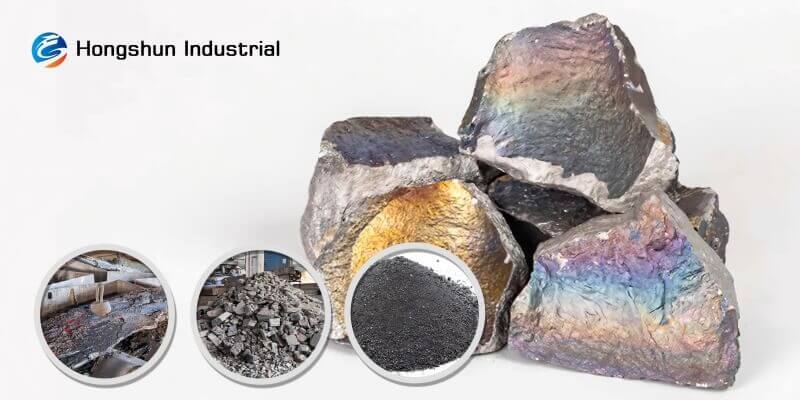

Ferro manganese is one of the most important ferroalloys used in modern steel production. It is an alloy of iron and manganese, typically containing between 65% and 80% manganese, depending on the grade. In steelmaking, it plays a crucial role not only as an alloying element but also as a powerful deoxidizer and desulfurizer. Without ferro manganese, producing high-quality steel with consistent mechanical properties would be far more difficult and costly.
Today, ferro manganese is widely used across construction, automotive, shipbuilding, and heavy machinery industries. Its importance in steel production continues to grow as global demand for stronger, cleaner, and more durable steel increases.


1. Deoxidation in Steelmaking
One of the primary uses of ferro manganese in steelmaking is deoxidation. During steel production, oxygen is naturally present in molten steel. If not removed, oxygen can form oxides that weaken the final product and create internal defects.
Ferro manganese acts as an effective deoxidizer. Manganese has a strong affinity for oxygen and reacts with it to form manganese oxide, which is removed as slag. This process helps produce cleaner steel with improved mechanical integrity.
Compared to other deoxidizers, ferro manganese is cost-effective and highly efficient, making it a standard additive in most steel grades.
2. Desulfurization Function
Sulfur is another harmful impurity in steel. It can cause brittleness, reduce ductility, and lead to cracking during processing or use. Ferro manganese plays a key role in reducing sulfur content in molten steel.
Manganese combines with sulfur to form manganese sulfide (MnS), which is more stable and can be removed easily during slag formation. This reaction significantly improves steel toughness and hot-working performance.
As a result, steel treated with ferro manganese exhibits better machinability and fewer defects, especially in high-stress applications.
3. Alloying Element for Strength Improvement
Beyond purification, ferro manganese is also an essential alloying material. When added to steel, manganese increases hardness, tensile strength, and wear resistance without significantly reducing ductility.
This makes it particularly valuable in the production of structural steel, rail tracks, armor plates, and automotive components. Even small additions of manganese can greatly enhance steel performance under heavy load conditions.
In many steel grades, manganese content is carefully controlled to achieve a balance between strength and flexibility.
4. Improving Hardness and Wear Resistance
Ferro manganese is widely used in steels that require high resistance to wear and abrasion. For example, in mining equipment, crushers, and railway tracks, steel components are exposed to constant friction and impact.
The addition of manganese helps steel maintain its structure under extreme conditions. It increases surface hardness while preserving internal toughness, which extends the service life of industrial components and reduces maintenance costs.
This property makes ferro manganese indispensable in heavy industry applications.
5. Role in Carbon Steel and Low-Alloy Steel
In carbon steel production, ferro manganese is commonly used to stabilize the steel matrix and improve overall performance. It helps control the interaction between carbon and iron, ensuring consistent quality during large-scale production.
In low-alloy steels, ferro manganese contributes to improved strength-to-weight ratio, making the steel suitable for bridges, buildings, pipelines, and pressure vessels.
Its versatility allows steelmakers to adjust composition according to specific industrial requirements.
6. Cost-Effective Steel Production Additive
Another reason ferro manganese is widely used is its cost efficiency. Compared to other alloying materials, it provides multiple benefits—deoxidation, desulfurization, and strengthening—in a single product.
This reduces the need for multiple additives, simplifying the steelmaking process and lowering overall production costs. For steel manufacturers operating in competitive markets, this economic advantage is highly significant.
Conclusion
Ferro manganese plays an essential and irreplaceable role in steelmaking. From removing impurities like oxygen and sulfur to enhancing strength, hardness, and durability, it directly influences the quality of modern steel products.
As industries continue to demand higher-performance materials, the importance of ferro manganese will only increase. Its combination of efficiency, versatility, and cost-effectiveness makes it one of the most valuable ferroalloys in the global steel industry.
For steel producers aiming to improve product quality and production efficiency, ferro manganese remains a key material in achieving these goals.

