
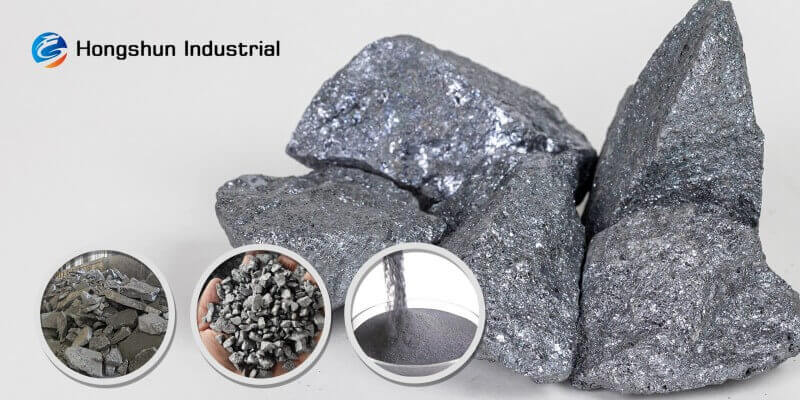

Ferrosilicon inoculant is widely used in iron foundries to improve the solidification behavior and microstructure of cast iron. By introducing active nucleation sites into molten iron, an appropriate inoculant can help promote graphite formation, reduce chill tendency, and improve the consistency of castings.
For foundries purchasing large quantities of casting additives, choosing a reliable ferrosilicon inoculant supplier in China can be important for both production stability and cost control.
What Is Ferrosilicon Inoculant?
Ferrosilicon inoculant is a silicon-based ferroalloy material used during the inoculation of molten cast iron. Its main component is ferrosilicon, while additional elements may be included to improve its inoculation performance.
Depending on the casting process and iron grade, inoculants may contain elements such as calcium, barium, strontium, zirconium or rare earth elements.
The basic purpose is not simply to add silicon. The inoculant helps create favorable conditions for graphite nucleation during solidification.
Why Is Inoculation Important in Cast Iron?
The solidification process has a major influence on the final properties of cast iron. Without effective inoculation, molten iron may have insufficient nucleation sites, increasing the risk of undesirable microstructures.
Proper inoculation can help:
- Promote graphite nucleation
- Reduce chill and carbide formation
- Improve graphite distribution
- Reduce the risk of casting defects
- Improve mechanical property consistency
- Support better machinability
- Increase production stability
The actual result depends on the chemical composition of the base iron, inoculant type, addition rate, temperature and inoculation method.
Ferrosilicon Inoculant for Gray and Ductile Iron
Ferrosilicon-based inoculants are commonly used for both gray iron and ductile iron applications. To understand the different types of inoculant for cast iron and how they are selected, see our detailed guide to cast iron inoculation.
For gray iron, inoculation is particularly important for controlling graphite formation and reducing the formation of excessive carbides. For ductile iron, inoculation works together with the nodularization process to support a suitable graphite structure.
Foundries should therefore select an inoculant according to the specific iron chemistry rather than simply choosing the product with the highest silicon content.
Choosing a Ferrosilicon Inoculant Supplier in China
Depending on the casting process and iron grade, inoculants may contain elements such as calcium, barium, strontium, zirconium or rare earth elements. Silicon barium inoculant is another common option for cast iron applications.
When sourcing from China, buyers normally look at several factors:
- Chemical composition: The content of silicon, calcium, barium, aluminum and other elements should remain within the agreed specification.
- Particle size: Different casting processes require different grain sizes. Common sizes can be supplied according to the customer’s feeding and inoculation system.
- Consistency: Stable composition from batch to batch is essential for maintaining consistent casting quality.
- Packaging: Moisture-resistant packaging is useful because excessive moisture can affect storage and handling.
- Inspection and documentation: For international orders, buyers may request chemical analysis reports, inspection documents and product samples before placing a bulk order.
Why Source Ferrosilicon Inoculant from China?
China has a well-developed ferroalloy and foundry materials industry, with established production capacity for ferrosilicon and various inoculant products.
A direct manufacturer can often provide more flexible specifications, particle sizes and packaging options than a trading channel. This can be particularly useful for foundries with regular consumption or special chemical requirements.
Hongshun supplies ferrosilicon-based inoculants for foundry applications and can provide different specifications according to casting requirements.
Final Considerations
The right ferrosilicon inoculant should be selected based on the entire casting process rather than price alone. Base iron chemistry, casting section thickness, pouring temperature and inoculation method all influence the final result.
For foundries looking for a ferrosilicon inoculant supplier in China, working directly with an experienced manufacturer can make it easier to control product consistency, particle size, packaging and supply. Buyers comparing different types of products can also learn more in our guide to choosing a foundry inoculant supplier.

