
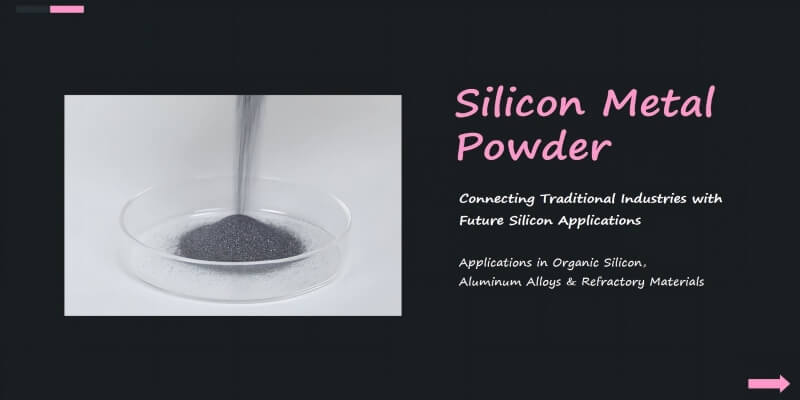

Silicon is an important raw material in many modern industrial processes. It is used in aluminum alloys, silicone chemicals, refractories, and a growing range of high-purity silicon-based materials.
As a processed form of silicon metal, silicon metal powder is produced in different particle sizes to meet the requirements of specific applications. Its chemical composition, particle size, and impurity levels can directly affect processing performance and the quality of the final product.
What Is Silicon Metal Powder?
Silicon metal powder is a fine-grained material produced by crushing, grinding, and screening silicon metal. The production process allows manufacturers to control the particle size according to the requirements of different customers and applications.
Depending on the application, silicon metal powder can be supplied with different:
- Silicon (Si) contents
- Iron (Fe), aluminum (Al), and calcium (Ca) levels
- Particle size ranges
- Particle size distributions
- Packaging specifications
For industrial applications, consistent chemical composition and particle size are particularly important. Variations in raw material quality can affect reaction efficiency, mixing performance, and the stability of downstream production.


Main Applications of Silicon Metal Powder
1. Organic Silicon Industry
The organic silicon industry is one of the major downstream applications of silicon metal.
In silicone production, silicon metal is first processed through chemical reactions to produce silicon-containing intermediates, which are then used to manufacture products such as silicone rubber, silicone oil, silicone resin, and other silicone materials.
Silicone products are valued for properties such as good temperature resistance, weather resistance, electrical insulation, and chemical stability. They are widely used in:
- Construction and building materials
- Electrical and electronic products
- Automotive components
- Industrial equipment
- Sealants and adhesives
- Chemical applications
The quality of the silicon raw material is important because impurities and particle characteristics can influence the efficiency and consistency of subsequent processing.
2. Aluminum Alloy Production
Silicon is also widely used as an alloying element in aluminum alloys.
In aluminum-silicon casting alloys, silicon improves the fluidity of molten aluminum and helps reduce shrinkage during solidification. This makes Al-Si alloys suitable for producing complex cast components.
Depending on the alloy composition and heat-treatment condition, silicon can also contribute to the mechanical and wear properties of the finished material.
Aluminum-silicon alloys are commonly used in:
- Automotive engine and transmission components
- Machinery parts
- Industrial equipment
- Pumps and housings
- Other cast aluminum products
For this application, the appropriate silicon specification depends on the alloy grade and the production process. Therefore, buyers normally pay close attention to Si content and Fe, Al, and Ca impurities when purchasing silicon metal.
3. Refractory Materials
Silicon metal powder is also used in certain refractory and metallurgical formulations.
Because silicon is stable under many industrial conditions and can provide useful chemical and physical properties within refractory formulations, silicon powder may be incorporated into materials designed for high-temperature environments.
Its use can contribute to properties such as:
- High-temperature performance
- Oxidation resistance
- Mechanical stability
- Wear resistance
The actual effect depends strongly on the refractory formulation, particle size, and other raw materials used. Silicon powder should therefore be selected according to the specific refractory system rather than treated as a universal additive.
4. Advanced Silicon-Based Materials
In addition to traditional applications, higher-purity silicon materials are being used in developing areas such as new energy, electronics, and advanced chemical materials.
Fine silicon powders with controlled chemical composition and particle size can serve as raw materials or process materials for certain advanced applications. For these markets, impurity control becomes increasingly important, particularly for elements such as iron, aluminum, and calcium.
The required specification can vary considerably between applications, so technical requirements should be confirmed before production and shipment.
Key Factors When Buying Silicon Metal Powder
For industrial buyers, silicon content alone is not enough to determine whether a powder is suitable for a particular process. Several factors should be considered.
Silicon Content and Chemical Composition
The Si content should match the requirements of the application. At the same time, impurity levels such as Fe, Al, and Ca need to be controlled within the required range.
Different industries may have very different limits, so buyers should confirm the complete chemical specification rather than selecting a product only by its nominal grade.
Particle Size
Particle size is another important factor.
Different production processes may require coarse particles, fine powder, or a controlled particle size distribution. Particle size affects mixing, reaction behavior, feeding, and material utilization.
A reliable supplier should be able to provide the required particle size or produce a customized specification when necessary.
Quality Consistency
For continuous industrial production, consistency from one shipment to the next is often more important than a single test result.
Stable Si content, controlled impurities, consistent particle size, and proper quality inspection help reduce variations in downstream processing.
Packaging and Delivery
Silicon metal powder should be packed appropriately for transportation and storage. Packaging requirements may vary according to particle size, quantity, destination, and customer handling procedures.
For international buyers, export experience and reliable delivery are also important considerations when choosing a supplier.
Choosing a Reliable Silicon Metal Powder Supplier
A suitable silicon metal powder supplier should be able to provide more than a competitive price. Buyers should consider the supplier’s production capability, quality control system, testing procedures, customization ability, and export experience.
Before placing an order, it is useful to confirm:
- Si content and complete chemical composition
- Fe, Al, and Ca impurity limits
- Particle size and tolerance
- Packaging requirements
- Inspection and testing methods
- Production lead time
- Shipping and export capability
Hongshun supplies silicon metal and related ferroalloy products for industrial customers in international markets. We provide silicon metal in different grades and sizes and can discuss particle size and chemical requirements according to the customer’s application.
For specific requirements, customers are welcome to provide their target Si content, impurity limits, particle size, quantity, and packaging requirements for evaluation and quotation.
Conclusion
Silicon metal powder is an important processed silicon material used in organic silicon production, aluminum alloys, refractory materials, and selected advanced material applications.
Its performance depends not only on silicon content but also on impurity levels, particle size, particle size distribution, and overall quality consistency. For this reason, selecting a supplier with stable production and quality control is important for long-term industrial use.
If you are looking for silicon metal powder with a specific chemical composition or particle size, contact Hongshun with your technical requirements for further information and a suitable quotation.

