
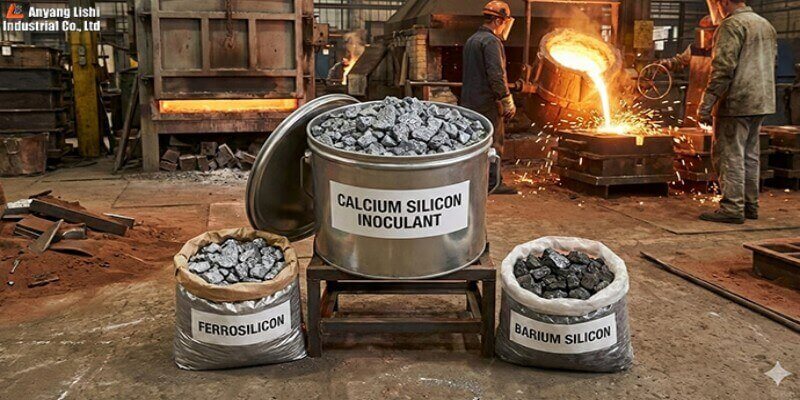

Silicon barium inoculant, commonly known as SiBa inoculant, is a widely used foundry additive for treating molten cast iron. It is particularly valued for its ability to improve graphite nucleation and support a more stable microstructure during solidification.
For foundries purchasing casting additives, choosing the right silicon barium inoculant manufacturer is important because chemical consistency and particle size can directly affect the inoculation process.
What Is Silicon Barium Inoculant?
Silicon barium inoculant is a silicon-based ferroalloy containing barium and other controlled elements. It is one type of ferrosilicon-based inoculant used in foundry applications. Silicon provides the main alloying contribution, while barium plays an important role in improving the inoculation effect.
The exact composition varies according to the grade and application.
A typical SiBa inoculant may contain:
- Silicon
- Barium
- Calcium
- Aluminum
- Iron
- Other controlled trace elements
The specification should always be checked against the supplier’s certificate of analysis.
How Does SiBa Inoculant Work?
During the solidification of cast iron, graphite needs suitable nucleation sites to form and grow. SiBa inoculation increases the number of effective nucleation sites available in the molten metal.
This can contribute to:
- Better graphite formation
- Reduced chill tendency
- Improved graphite distribution
- More stable casting structure
- Better machinability
- More consistent casting quality
The effect depends on factors such as treatment temperature, holding time and addition method.
Applications of Silicon Barium Inoculant
SiBa inoculants are widely used in foundries producing different types of iron castings. For a broader comparison of inoculant types and their applications, see our guide to inoculants for cast iron.
Typical applications include:
- Gray iron: SiBa inoculant can help promote a suitable graphite structure and reduce unwanted carbide formation.
- Ductile iron: It can be used after nodularization to improve graphite nucleation and support a consistent matrix and graphite structure.
- Thin-wall castings: Proper inoculation can help reduce the risk of chill formation in certain casting conditions.
Why Particle Size Matters
The particle size of an inoculant should match the feeding system used by the foundry.
For example, fine particles can react relatively quickly, while larger particles may provide a different dissolution and reaction profile.
Commonly supplied sizes can include several millimeter ranges, depending on the application.
A professional silicon barium inoculant manufacturer should therefore be able to provide different particle sizes rather than offering only one standard product.
How to Choose a SiBa Inoculant Manufacturer
Silicon barium is one of several ferrosilicon-based inoculants used in modern foundry production. Before purchasing, international buyers should compare:
- Chemical composition
- Barium content
- Silicon content
- Particle size
- Moisture control
- Packaging
- Batch consistency
- Inspection reports
- Production capacity
- Export experience
Price is important, but a low-cost inoculant is not necessarily economical if inconsistent chemistry results in unstable casting performance.
Silicon Barium Inoculant from China
China is one of the major global sources of ferroalloys and foundry additives. Direct purchasing from a Chinese manufacturer can offer advantages in product customization and supply capacity.
Hongshun supplies silicon barium inoculant for international foundry customers and can discuss chemical composition, particle size and packaging according to specific production requirements.
Conclusion
Silicon barium inoculant is an important material for controlling graphite nucleation and improving the consistency of cast iron. Selecting the correct SiBa grade requires consideration of both chemical composition and casting conditions.
For buyers searching for a silicon barium inoculant manufacturer, a supplier with stable production, quality control and flexible specifications can provide better long-term value. Foundries can also compare other products and sourcing considerations in our guide to foundry inoculant suppliers.

